

As businesses increasingly adopt AI, more organizations are investing in AI projects to improve efficiency, automate processes, and generate insights. While AI can bring many benefits, blindly jumping on the trend without enough preparation can lead to wasted money without seeing the intended results. That is why it is important to understand what causes AI projects to fail and what steps are needed to prevent it.
The Growing AI Investment Gap
Organizations across industries are investing heavily in AI to streamline processes, improve customer experiences, and generate new insights. Yet significant investment does not always translate into business results. According to research by Orgvue, 78% of organizations have seen AI projects either fail (35%) or remain stuck in the pilot stage (43%).
The challenge is often not the AI technology itself. Many projects struggle due to inadequate planning, poor data quality, and infrastructure that cannot support the demands of AI workloads. These challenges can create a widening gap between AI investment and actual business value. To close that gap, companies need to approach AI as a broader business transformation initiative rather than a one-time technology experiment.
Aligning AI with Business Goals
Many choose to start AI projects because it is the current trend, not because it helps solve a challenge in the business. When there is no clear goal, such as cost savings or improved customer experience, AI projects will not seem appealing to company executives. Successful AI projects start with defining measurable outcomes (such as shorter process times or faster problem detection) and work toward the right AI approach. This way, stakeholders can give those AI projects success metrics that actually contribute to the business.
Closing Data Quality and Governance Gaps
Garbage in, garbage out. AI is only as good as the data it takes in. Many companies realize later that their data is poorly documented, which can waste the team’s time on data clean-up instead of the AI project itself. Poorly documented data can also create compliance risks. When this gap is closed, there will be clear data ownership, good quality checks, and a clear pipeline before the AI model is tested. When companies invest in a strong data foundation, they get a faster development cycle and better AI outcomes.
Avoiding Hype and Tech-First Decisions
Many are only in it for the hype, without a clear goal or use case, and that’s a fast way to ruin an AI project. Instead, companies should evaluate AI tools for their operational needs, systems, and team capability before adopting them. This process may take longer, but it is more likely to lead to successful results than jumping on the trend and having to rework everything once the hype dies down later.
Solving Infrastructure and Scalability Challenges
Old infrastructure with limited compute can make it difficult for AI projects to scale. For an AI project to succeed, a business needs scalable infrastructure that can grow as workload increases, support model training, and integrate smoothly with existing systems. Having cloud and hybrid infrastructure built for AI needs can also help businesses avoid these bottlenecks, giving the AI model the compute, storage, and networking it needs to support everything from testing to full production.
Implementing Governance and Security into AI Projects
Security and governance are often only added when a model is almost ready to launch. This can expose the company to breaches, biased outcomes, and even regulatory penalties. A good AI project should implement security and governance from the start. This means access control, regular audits and testing, as well as accountability for decisions. This doesn’t slow innovation, instead, it can prevent costly modifications and reputational damage later on. Businesses should treat security as a core element, not just a checkbox.
Moving Enterprise AI from Concept to Production
Organizations often fail to move AI projects beyond the concept stage because they overlook production readiness. Moving from concept to deployment needs integration with live systems, constant performance monitoring, and ongoing maintenance. It also requires dedicated resources. When companies plan for scale from the start, instead of leaving it as an afterthought, they are more likely to deliver lasting value instead of stalling indefinitely.
Best Practices for Successful Enterprise AI
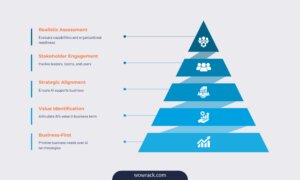
Below are some of the best practices businesses can implement before executing an AI project.
Define Clear Business Goals
Successful AI projects mostly start with a specific, measurable business goal instead of something vague like “let’s just switch to AI now.” It is important to have a clear KPI or measurable metric for each AI project that defines what success should look like. This can be reduced cost, faster processing, or better accuracy. Having clear goals like these can help teams stay focused, speed up stakeholder approval, and give a benchmark for evaluating whether the project is actually delivering value.
Build a Strong Data Foundation
Having reliable, well-governed data is the foundation of every AI system. Before launching an AI project, companies need to audit all data sources and establish clear ownership for each dataset. When this is skipped, it can lead to inaccurate output and may require a lot of rework later. A proper data foundation can speed up development, improve model performance, and reduce the compliance risk that comes with poorly managed information.
Choose the Right AI Infrastructure
Choosing the wrong infrastructure can hinder an AI project from scaling. To handle growing workloads, AI projects need the right compute, storage, and network resources. This is why it’s always recommended to choose a flexible environment instead of forcing AI to fit into old systems, which can lead to bottlenecks and downtime. The right infrastructure partner can also help with monitoring and provide the support needed to keep AI models running smoothly as needs grow.
Conclusion
Many enterprise AI projects struggle to move from experimentation to measurable business value. Most of these failures are caused by unclear goals, weak data foundations, decisions driven by trends, and unscalable infrastructure. The good news is that these causes are preventable. Companies that succeed treat AI as not just a one-time technology, but a business initiative, implementing governance, security, and proper planning from the start. Those that succeed also rarely do so on their own, as many of them partner with a reliable infrastructure partner.
Wowrack has been delivering enterprise-grade hosting and reliable infrastructure solutions to businesses across industries around the world since 2001, partnering with clients to help manage their cloud, hybrid, and dedicated infrastructure so teams can focus on delivering innovation instead of maintenance. In short, Wowrack helps provide enterprises with the scalable, secure foundation they need to execute AI projects.