
Most organizations today face increasing pressure to protect their endpoints as cyber threats continue to evolve. Devices such as laptops, servers, and employee workstations are often connected to corporate networks, which makes them attractive targets for attackers. While many businesses still rely on traditional antivirus software, others are beginning to adopt more advanced tools like Endpoint Detection and Response (EDR). Understanding the differences between EDR vs antivirus helps security teams determine which approach better supports their infrastructure, operational requirements, and overall risk management strategy.
Security investments are also rising as organizations recognize these risks. According to PwC’s 2024 Global Digital Trust Insights, about 85% of organizations plan to increase their cybersecurity budgets. This shift shows how important endpoint protection has become in modern IT environments.
What is Endpoint Security
Endpoint security focuses on protecting the devices that connect to an organization’s network. This includes laptops, desktop computers, servers, and devices used by remote employees. Each endpoint represents a potential access point into the network if it is not properly secured.
Because attackers frequently target these devices first, organizations need tools that can monitor and defend them effectively. Modern endpoint security solutions now go beyond simply blocking malware. They also help detect unusual activity and identify potential threats before they develop into larger security incidents.
How EDR Works
Endpoint Detection and Response (EDR) solutions continuously monitor activity across connected devices. Instead of focusing only on known malware signatures, EDR collects endpoint data and analyzes system behavior in real time.
When suspicious actions are detected, the system can alert security teams and sometimes isolate the affected device to prevent further spread. EDR platforms also provide investigation capabilities, allowing analysts to review activity logs, trace how an attack occurred, and determine which systems or devices were involved.
What is Antivirus?
Antivirus software is one of the most popular security tools, as a lot of people use it. It is able to detect, block, and remove malicious programs from devices. For a long time, antivirus software has been the main defense against malware attacks. Newer versions of antivirus programs may offer additional features, but the main purpose of them remains the same, which is to identify harmful software before it damages the system.
How Antivirus Works
Antivirus programs usually rely on signature-based detection. This means that they compare files and processes with a database of known malware signatures. When they find a match, the software will block or remove the threat. Some software also uses basic behavioral analysis, but its main strength lies in finding previously known malware patterns.
Differences between EDR vs Antivirus
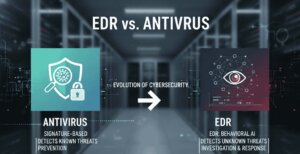
Source: cybersecuritysolutions.ae
Even if they both can protect endpoints, their approach and capabilities can be a bit different. The discussion around EDR vs antivirus often comes down to visibility and response capabilities.
Detection Method
One of the first main differences between EDR vs antivirus is how threats are detected by each of them. EDR analyses endpoint behaviour, meaning that they track processes, system activity, and network interactions to find suspicious patterns, even when the threat has never been seen before.
On the other hand, antivirus relies more on known malware signs. If a threat matches a known pattern, it will get blocked.
Threat Visibility and Monitoring
When comparing EDR vs antivirus, one of the main differences is how threats are detected. EDR offers broad monitoring across endpoints, allowing security teams to see system activities, trace attack timelines, and analyze how threats move through the environment. This can help organizations understand security incidents better.
Original antivirus software usually focuses only on preventing infections, so once the threat is removed, users cannot really see what happens afterward.
Response Capabilities
EDR platforms allow users to take various response actions, meaning that users can choose to isolate devices, stop suspicious processes, and investigate incidents from a centralized panel, giving flexibility to contain threats before they spread further.
Antivirus software, on the other hand, has more limited response actions as they usually can only quarantine or delete the detected malware automatically.
Benefits of Using EDR
EDR focuses on deep visibility and response capabilities from various endpoint environments.
Advanced Threat Detection
EDR systems analyse the endpoints’ activity and behaviour to find threats that may pass antivirus software. This may include unknown or newer malware and suspicious processes.
Real Time Incident Response
With EDR, security staff can isolate compromised devices, stop malicious processes, and respond to incidents quickly, thanks to being able to manage them from the EDR platform directly.
Threat Hunting and Forensic Analysis
EDR tools give their users the ability to search the history of endpoint data and investigate attack patterns in order to understand how those security incidents can happen in the first place.
Benefits of Using Antivirus
Antivirus software is still useful for many, especially for basic endpoint protection.
Protection Against Known Malware
Antivirus tools are quick at detecting known malware, as their databases give them the ability to quickly identify previously detected threats and block them before they infiltrate the system.
Easy Deployment and Cost Efficiency
Most antivirus software is easy to use and install. They don’t require advanced knowledge, can be configured in a simple way, and their prices are very competitive, making it a good option for smaller businesses with limited resources.
When Should Businesses Use EDR Instead of Antivirus?
A lot of businesses move to using EDR when their security needs more than basic malware protection.
Enterprise Security Needs
Bigger businesses usually need to take care of lots of endpoints daily. For this, visibility is important, and EDR can help with that. EDR provides centralized monitoring and detailed activity logs that can help the teams of larger organizations detect and respond to threats across multiple systems at once.
Protection Against Advanced Threats
Advanced cyber-attacks usually use file malware, stolen credentials, or other modern techniques that traditional antivirus software may miss because it is unfamiliar with them. EDR solutions can identify these newer threats by monitoring the behaviour of the system and network activity, giving teams the ability to investigate more efficiently.
Can EDR Replace Antivirus?
For some, EDR can replace antivirus tools, but many actually still use both at the same time. This is because they have different specialties, as EDR focuses on detection, investigation, and response, while antivirus is good at handling known malware. When combined, they create a stronger security approach that shields endpoints against both common and advanced threats.
Conclusion
When it comes to choosing between EDR vs antivirus, at the end of the day, it all depends on the needs and infrastructure size of your business. Antivirus offers basic protection, while EDR offers visibility, detection, and response features that can help your business defend against advanced cyber attacks.