
Imagine you are walking into a modern restaurant. You place your orders and take a seat at a nice window-side table to see the view. Unfortunately, you are not the only one who has the view, but so do the others outside the glass. That is how it feels like running today's digital business.
What really happens nowadays is that the attacks that come your way aren’t just happenstance. Today’s cyber threats are sophisticated, targeted, and persistent. Ransomware, phishing, and insider leaks are among the threats that can damage your customers’ trust in your business and your income.
The traditional 9-5 in-house security doesn’t cut it anymore. You need a partner who watches the gate while you focus on building the business. That is where an MSSP comes in.
What is an MSSP Service?
What is an MSSP or Managed Security Service Provider? If your standard IT team serves as the architects and builders keeping your digital infrastructure running, the MSSP is the elite security force monitoring the perimeter, checking IDs at the door, and neutralizing threats before they ever break a window.
This means that, unlike traditional IT teams, an MSSP focuses only on security operations. Their services usually include:
- 24/7 Security Operations Center (SOC)
- Security Information and Event Management (SIEM)
- Endpoint Detection and Response (EDR/XDR)
- Vulnerability management
- Threat intelligence integration
- Incident response and forensic analysis
Different MSP vs MSSP
It is easy to confuse the two, but the difference is critical.
- MSP (Managed Service Provider): Focuses on uptime. They keep the servers running, the software updated, and the emails flowing. They are your pit crew.
- The MSSP (Managed Security Service Provider): Focuses on safety. They analyze traffic, lock down the endpoints, and investigate the suspicious noise in the logs. They are your infrastructure bodyguards.
Understanding these differences becomes critical as cyber risk grows. The Cybersecurity and Infrastructure Security Agency (CISA) emphasizes continuous monitoring and threat detection as foundational components of enterprise security strategy.
Why Are US Enterprises Prime Targets for Cyber Threats?
Unfortunately, bad actors consider US businesses the “big fish”. You have the data, the transaction volume, and the intellectual property that they can either sell or ransom back to you. Another thing is the advancement of adoption.
US businesses have long adopted digital transformation and are often at the forefront in terms of adopting new technology. Thus, complex setups such as hybrid clouds, remote workers, and third-party vendors that are full of vulnerabilities are also available for them to exploit.
Remember that their attack surface accelerates in line with how fast businesses transform into digital environments.
Most Common Cyber Threats Facing US Enterprises
You know the villains, but let’s look at what they actually do to your business.
Ransomware
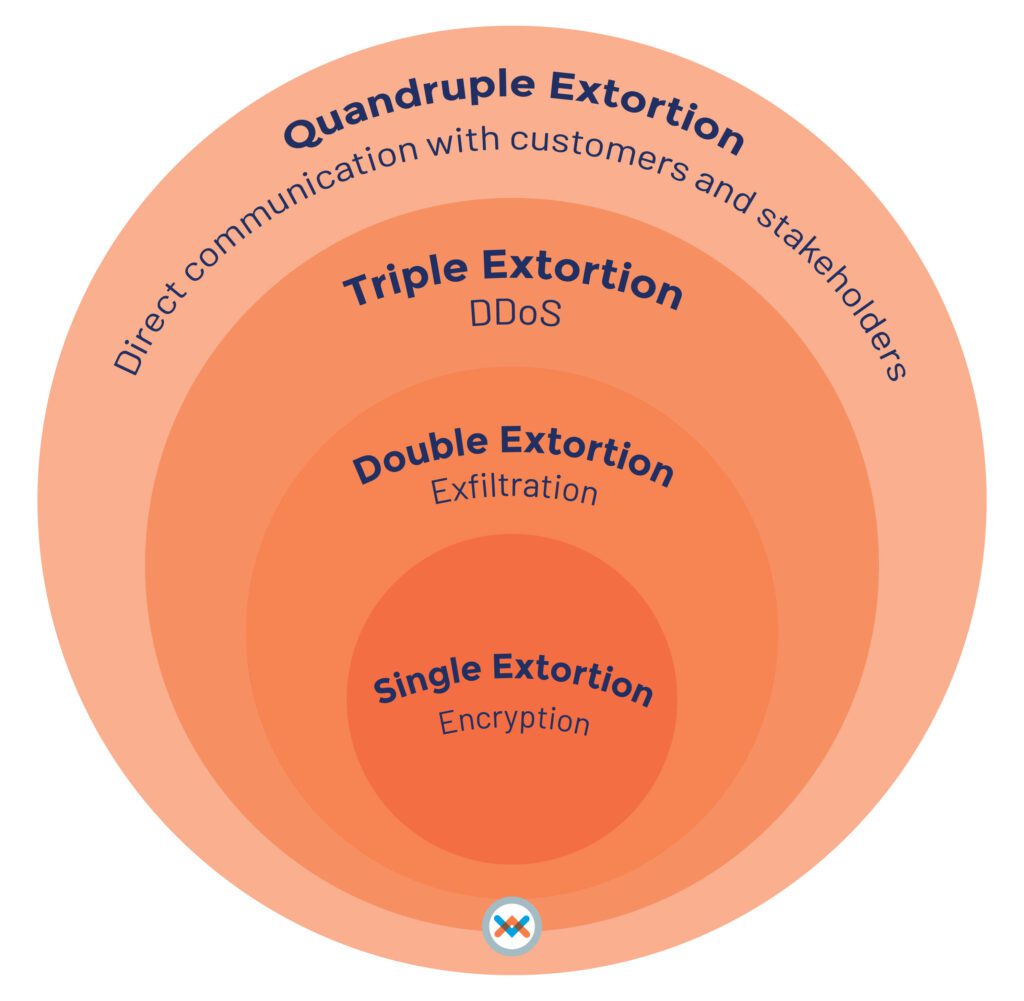
Ransomware remains one of the most disruptive cyber threats. Attackers encrypt enterprise data and demand payment for decryption keys. Increasingly, they use what is known as “double extortion”, where they steal data before encrypting it and threaten to release the data to the public.
Through their research, Verizon found that 24% of breaches involved ransomware in 2024.
Phishing
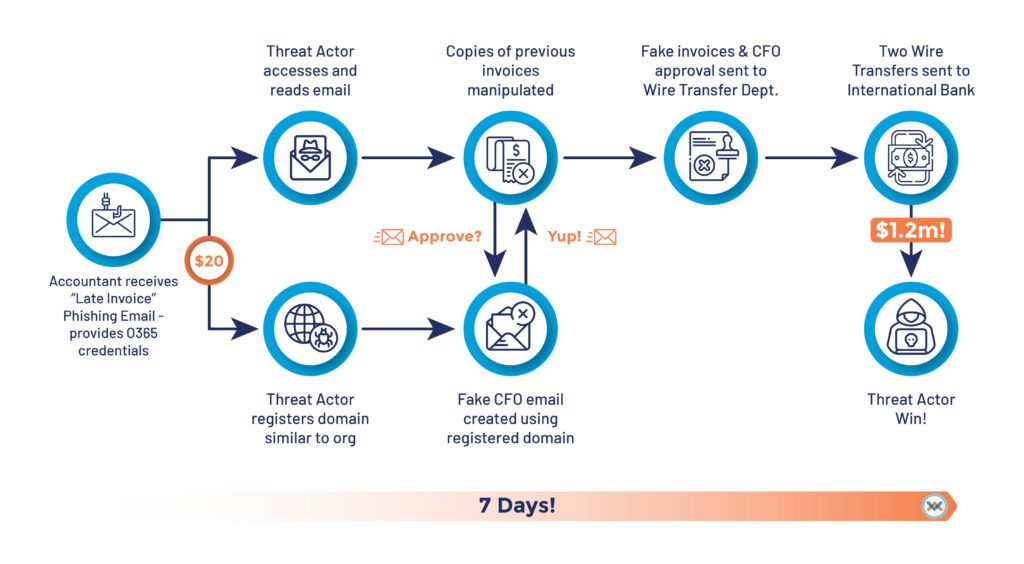
Phishing attacks exploit human behavior rather than technical vulnerabilities. Attackers often impersonate important people or institutions to steal login credentials from their targets.
With how advanced AI is nowadays, phishing attacks are also found to use AI to aid their efforts in breaching businesses' security.
Insider Threats
Insider threats can be malicious or accidental. Employees with legitimate access may misuse privileges or expose sensitive data unintentionally.
According to Ponemon Institute research, insider-related incidents continue to increase in frequency and cost, especially now with hybrid work models, complicating monitoring.
Supply Chain Attacks
Attacks on supply chains work by compromising your 3rd party vendors and using them to infiltrate their customers, including your business. CISA has repeatedly warned about third-party software risks, emphasizing vendor risk management and software integrity verification.
How to Protect Enterprise Infrastructure?
Having tools is great, however only having tools doesn’t solve your security problems. It also needs people and experts. Here is how MSSP can help protect you.
Real-Time Monitoring
Real-time monitoring enables immediate detection of suspicious activity across endpoints, servers, networks, and cloud environments. MSSP services often help you analyze logs, correlate events, and identify anomalies using advanced analytics.
By reducing attacker action time, businesses limit the data loss potential and operational disruption.
Automated Threat Containment
Automation is critical during active cyber incidents. Automated containment tools can help your team isolate compromised devices, disable accounts, and block further malicious traffic within seconds of an incident.
A proper MSSP integrates all of your automated responses, preventing threats from spreading across multiple environments.
Enterprise Visibility Across Hybrid Environments
With how many interconnected applications and tools businesses use in their daily operations, it is no wonder that businesses also operate across multiple infrastructures. These wide operations create a gap, increasing blind spots and risk exposure.
Centralizing telemetry into a unified dashboard allows your business to have full visibility across infrastructures and helps you achieve better results.
24/7 Security Monitoring and SOC Operations
Cyberattacks do not follow your business hours. Having a Security Operations Center that can secure your infrastructure 24/7 can help better save your business. From monitoring alerts, conducting threat hunting, performing log analysis, or escalating incidents based on severity, SOC helps your business to be continuously covered.
Incident Response and Threat Mitigation
Even with preventive controls, incidents can still happen. By having a structured incident response procedure, businesses can minimize the damage of incidents and quickly restore operations. What MSSP can help you in this case is varied, from forensic investigation, root cause analysis, containment strategy, and up to recovery guidance.
Enterprise-Class MSSP Service Features
Comprehensive MSSP services must include advanced cybersecurity capabilities that can be tailored to your business environment. From:
SIEM
Security Information and Event Management (SIEM) is a platform that helps comprehensively collect and analyze logs from across your infrastructure.
A properly managed SIEM enables real-time alerting, compliance reporting, and threat correlation. MSSP experts fine-tune SIEM configurations to reduce false positives and enhance detection accuracy.
EDR/XDR
Endpoint Detection and Response (EDR) enables your business to monitor device-level activity, while Extended Detection and Response (XDR) expand visibility across networks, email, and cloud platforms.
Together, these tools provide comprehensive threat detection and coordinated response, strengthening enterprise cybersecurity posture.
Vulnerability Management & Threat Intelligence
Vulnerability management identifies your system's vulnerabilities before attackers exploit them. Through regular scanning and risk prioritization, businesses can reduce their exposure to current cyber threats.
Threat intelligence enhances security posture by tracking emerging attack patterns and adversary tactics. MSSP services combine both approaches to strengthen proactive defense.
Pentest
Penetration testing simulates real-world attack scenarios to evaluate system defenses. By identifying exploitable vulnerabilities, enterprises can remediate weaknesses before they are targeted by malicious actors.
MSSP Service vs In-House Security Team
Now the question is, could you build everything we have discussed internally? Sure. But hiring a full team of security analysts, buying enterprise-grade tools, and running it 24/7 is incredibly expensive.
This is where MSSP comes in to help you. They offer scalable, cost-effective protection with access to experienced analysts and technology. In other words, MSSP provides your business with predictable operating costs while maintaining a strong security posture.
How to Choose the Right MSSP Service for Enterprises
Selecting the right MSSP Service is a strategic decision. Enterprises should evaluate the provider’s industry experience, compliance expertise, technical capabilities, and scalability.
Key considerations include:
- 24/7 SOC coverage
- Advanced SIEM and EDR/XDR integration
- Defined Service Level Agreements (SLAs)
- Transparent reporting and escalation procedures
- Support for regulatory compliance requirements
The ideal MSSP partner functions as an extension of your security team, one that is proactive, responsive, and aligned with your business risk tolerance and objectives.