
Cloud adoption has grown rapidly over the past decade. Initially, the focus was on moving workloads to the cloud as quickly as possible, but now, the focus has shifted as the challenges of managing cloud environments have become more complex. Security requirements have grown, cloud spending has increased, and many businesses operate across multiple cloud platforms. Today, a cloud strategy is considered successful not simply because workloads have been migrated to the cloud, but because it achieves the right balance between performance, security, scalability, and cost efficiency to support long-term business goals.
What is an Enterprise Cloud Strategy?
Enterprise cloud strategy refers to a plan that guides how a business adopts, manages, and optimizes the cloud. Cloud strategy makes sure that all decisions regarding technology are in line with the business goals.
A proper cloud strategy can help businesses decide where applications should run, how data should be protected, how costs should be managed, and how resources should support future growth. A good strategy comes with a framework for governance, security, and operational consistency across all cloud environments within the business.
Why Traditional Strategies Don’t Work
The cloud landscape is evolving, and that brings new challenges that older strategies may not be enough to handle. Below are some of the common reasons for that:
Rise of Multi-Cloud Environments
Many businesses today don’t just use a single cloud provider. They utilize multiple cloud platforms for different purposes and requirements, which provides flexibility but also makes management, security, and visibility more complex. Traditional strategies often cannot support these complexities as most of them focus only on single-cloud environments.
Growing Security and Compliance Needs
As cyber threats continue to evolve, security has become a critical part of every cloud strategy. According to IBM, the global average cost of a data breach is USD 4.4 million, highlighting the financial impact that security incidents can have on organizations. Businesses must ensure they meet data protection and regulatory compliance requirements by implementing access controls, continuous monitoring, and other security measures. Simply moving workloads to the cloud is not enough; organizations must also secure their cloud operations.
Challenge of Controlling Costs
Cloud offers flexibility, but costs remain high when there is no proper management in place. Unnecessary spending is often caused by unused resources, improper configurations, as well as lack of visibility. Simply moving to the cloud is not enough to ensure lower tech spending, making financial management an important component of a modern cloud strategy.
What Works in Enterprise Cloud Strategy Today
Practical approaches that balance flexibility, security, and efficiency are often what makes a business successful in terms of cloud adoption.
Hybrid Cloud for Flexibility
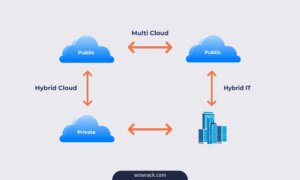
Hybrid cloud helps combine resources from on-premises infrastructure with public or private cloud, allowing businesses to put their workloads where they fit best in terms of security, performance, or compliance needs. Hybrid cloud allows businesses to modernize without requiring a complete infrastructure overhaul.
Multi-Cloud for Resilience
Multi-cloud strategies allow businesses to utilize services provided by multiple cloud providers instead of depending on just one provider. This helps reduce the reliance on just one vendor, thus improving availability and providing greater flexibility when it comes to choosing cloud services. Many businesses have utilized this strategy for continuity planning.
Cloud FinOps for Cost Optimization
With Cloud FinOps, businesses can manage cloud spending better as it combines financial decisions with operational visibility. Thus, helping businesses identify which areas have caused inefficiencies, optimize the usage of resources, and make better decisions when it comes to cloud investments.
Automation and Infrastructure as Code
When it comes to managing cloud resources manually, it can become very challenging especially when the business grows and the infrastructure becomes more complex. Infrastructure as Code helps businesses to automate key processes, including provisioning, configuration, and deployment through code templates. This way, businesses can ensure consistency, reduce human error and enable IT teams to deploy resources more efficiently.
Managed Cloud Services for Operational Efficiency
Many businesses do not have the resources needed to manage cloud environments effectively. Managed cloud service providers can help with this, as they help handle everything from monitoring, maintenance, optimization, and troubleshooting without adding to the workload of internal IT teams, giving them more time to focus on core business activities instead.
Common Cloud Strategy Mistakes
No business is immune to errors. Even the ones that have made lots of investment can still face challenges when they don’t have a proper plan.
Migrating Without a Roadmap
Lots of migration projects don’t go well when there are no clear goals or timelines. A structured roadmap can help make sure that all migration efforts are in line with the business goals and requirements.
Ignoring Security
Security is a crucial part of every cloud strategy. When security is underestimated, it opens environments to cyber risks and can create additional costs later.
Overprovisioning Resources
Many businesses decide to purchase more resources than needed for “what if” scenarios. Though this may look good in short term, it may lead to unnecessary costs and can hurt cloud budgets.
Lack of Visibility
When businesses have a distributed cloud environment, maintaining visibility can be challenging yet very important, because without proper monitoring strategies, businesses can have difficulties in identifying problems, security issues, and inefficient resource use.
How to Build an Enterprise Cloud Strategy
Coming up with a proper strategy needs both technical planning and business alignment.
Assess Current Infrastructure
Businesses need to begin with an evaluation of their current setup. This includes applications and all operational requirements. Proper evaluation helps identify which workloads are best suited for cloud adoption and which need alternative approaches.
Define Business Goals
Cloud initiatives need to align with business goals. This can include scalability improvement, cost reduction, security strengthening, or faster innovation. Having clear goals can help navigate decisions.
Choose the Right Model
Not every type of workload can fit perfectly in the same kind of environment. Businesses need to analyze which of the following models—public cloud, private cloud, hybrid cloud, or multi-cloud—can best support their needs.
Establish Governance Policies
Having strong policies can help businesses in maintaining consistency across different cloud environments. When making these policies, businesses must keep in mind security, access management, compliance, resource allocation, and cost control to ensure long-term success.
Enterprise Cloud Solutions for Businesses
Managing an entire cloud environment on your own is no easy task. It requires expertise in migration, security, monitoring, disaster recovery and infrastructure optimization. Partnering with a reliable provider like Wowrack can help businesses address those challenges through reliable managed cloud services, cloud migration support, email security, cybersecurity solutions, managed service, disaster recovery planning, as well as monitoring infrastructure.
The combination of those services can help improve efficiency, strengthen cybersecurity, and give businesses the visibility into their infrastructure while supporting long-term growth.
Conclusion
Modern cloud strategies need more than just moving the workloads to the cloud, it needs a balance between flexibility, security, scalability, and cost management. Approaches like hybrid cloud, multi-cloud, FinOps, automation, as well as managed services are now playing an important role in successful cloud operations. With a proper cloud strategy, businesses can build a stronger foundation for growth while mitigating challenges that come with unmanaged cloud environments.