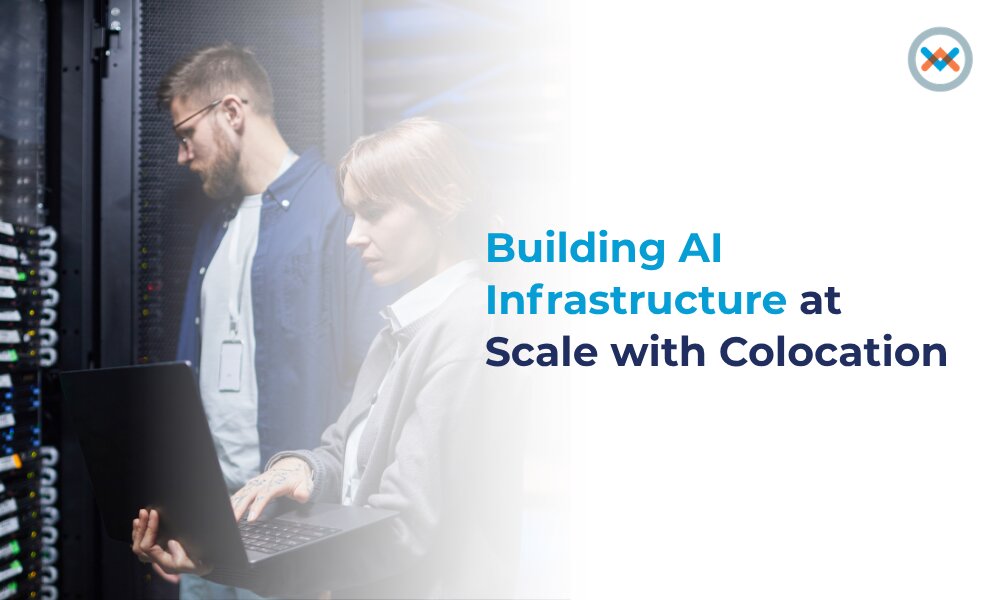

AI workloads are changing the infrastructure requirements of modern businesses. Training and running AI models can require high-performance GPUs, high-speed networking, high-density power, and advanced cooling that traditional data center environments may not be designed to support.
For businesses looking to deploy dedicated AI infrastructure, building a new data center can require significant capital, time, and operational resources. AI-ready colocation offers an alternative by providing the power, cooling, connectivity, physical security, and data center environment needed to host dedicated GPU infrastructure—without requiring the business to build and operate its own facility.
What is AI Infrastructure?
AI infrastructure combines hardware, software, and physical systems needed to develop, train, deploy, and run AI workloads. GPU servers provide the processing power needed for AI and ML tasks, and high storage capacity helps handle the large amounts of data generated and processed by these applications.
AI infrastructure mostly depends on fast networking for efficient data transport between systems. The physical environment is also important. High-performance GPU systems need enough power, cooling, connectivity, and strong security. As AI workloads grow, businesses need infrastructure that can support not only current requirements but also future growth.
Why AI Infrastructure Is Becoming a Priority
Training AI workloads needs far more compute than standard apps, and GPU supply lately can’t keep up with demand. This has led many teams to face rising costs and long lead times. Because of this, AI infrastructure planning has therefore become a priority for IT leaders and business stakeholders. Businesses that can secure scalable and reliable compute early can gain an advantage over competitors that are still waiting for hardware or replacing outdated facilities.
The challenge lies in managing and obtaining the right GPU infrastructure, as businesses need to think about hardware availability, power, cooling, storage, and networking on top of the GPU cost.
The Challenges in Scaling AI Infrastructure
Scaling AI infrastructure comes with challenges, especially since companies now need to support high-performance GPU workloads.
GPU Availability
Enterprise-level GPUs can be pricey and difficult to get your hands on. Businesses might also need more than one GPU to support their requirements, such as model training and data processing. After buying the hardware, businesses will also need compatible servers, storage, network, power, and cooling.
Power Density
Because AI needs high-performance GPUs to function well, these GPU servers actually require more power than the servers businesses typically use. With more GPUs deployed in a smaller space, power density can become a limiting factor. Companies need the right power capacity and distribution system to ensure smooth deployment.
Cooling High-Density AI Racks
More compute power equals more heat. Traditional air cooling might be enough for some deployments, but high-density AI needs more advanced cooling systems. Without enough cooling, the heat can affect system performance, reliability, and hardware lifespan.
High-Speed Networking
AI workloads usually process large volumes of data between GPUs, storage, and other infrastructure components. Slow or unreliable networking can create bottlenecks and limit performance. High-speed, redundant connectivity is important to ensure the best outcome.
Rising Infrastructure Costs
AI infrastructure cost isn’t just about the GPU, it also includes the investment required in servers, storage, networking, power, cooling, physical space, and maintenance. When a business operates all of this infrastructure on its own, capital and operational expenses rise sharply.
Why Colocation Is Ideal for AI Infrastructure
With colocation, businesses can deploy their hardware in a professional, well-maintained data center without needing to build and operate their own facility.
This is especially useful for AI infrastructure needs, since high-performance GPU deployments require greater power, cooling, connectivity, and security. The right colocation facility can provide all of this while still giving businesses control over their hardware. For many SMEs, the cost of AI infrastructure extends well beyond the GPU itself, including servers, networking, storage, power, cooling, software, facility costs, and ongoing operations. Colocation offers a middle ground: businesses buy the hardware they need and let a data center partner handle the power, cooling, and connectivity around it.
AI Colocation Components You Should Look For
Not all colocation facilities are built for high-performance AI workloads. Companies need to evaluate whether a facility can support their deployment requirements.
GPU-Optimized Cabinets
AI deployments may need specialized cabinets with the right space, power, and capacity for advanced GPU servers.
High-Density Power
The right facility must have enough power to support demanding GPU deployments, and a redundant power system can help increase availability.
Liquid Cooling Support
Depending on rack density and GPU configuration, AI deployments may require advanced cooling technologies such as direct-to-chip liquid cooling or rear-door heat exchangers.
Redundant Connectivity
Fast, reliable networking is crucial for moving large amounts of data between GPUs, storage, and other systems.
Security and Compliance
AI workloads may process sensitive and confidential data. Physical access control, monitoring, and other security measures can help protect deployed hardware.
Disaster Recovery
Businesses need to think about how AI infrastructure fits into their business continuity plans. Having a backup system and DR planning can help reduce the impact of unexpected incidents.
AI Colocation vs Public Cloud
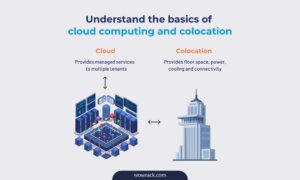
Both colocation and public cloud can support AI workloads, but the better choice depends on business needs. Some businesses may also use a combination of both, depending on their load and requirements.
AI colocation offers more predictable costs for consistent, long-term GPU usage, and can be cost-effective for steady, long-term workloads. It also supports specific physical and infrastructure needs and gives businesses greater control over dedicated physical infrastructure. However, for scalability, AI colocation requires more planning and additional hardware deployment.
Public cloud, on the other hand, offers flexible costs and ROI for variable or short-term needs, though costs can increase with usage. Its capabilities and security also depend on the provider and selected service. However, in terms of resource scalability, its resources can generally be provisioned faster than AI colocation.
How to Deploy AI Infrastructure
Below are the steps to deploy AI infrastructure successfully:
Assess GPU Workloads
Companies should start by identifying the types of AI workloads they need to run. This can include model training, inference, data processing, and AI app development, since different workloads have different needs.
Plan for Future Growth
AI projects can move quickly from development to production, so businesses must also consider future requirements for GPU, power, storage, rack space, and network before deployment.
Design for High Availability
To reduce downtime risk for AI workloads, having redundant power, network, and other infrastructure components is important.
Optimize the Cooling Strategy
Businesses need to decide whether traditional air cooling is enough or whether they need a more advanced solution, since cooling should match the density and performance needs of the hardware.
Monitor Infrastructure Continuously
To prevent small incidents from becoming larger ones, continuous monitoring can help identify performance issues, power problems, environmental conditions, and unusual activity.
Example: Supporting Enterprise AI Workloads
Imagine a company developing an AI platform that needs to process large amounts of data and requires dedicated GPUs for model training and inference. As the project grows, the company may need more power, storage, and network capacity, but building a dedicated data center to meet these needs would take significant investment and resources. Instead, the company deploys dedicated GPU infrastructure in a colocation facility with high-density power, reliable connectivity, security, cooling, and helpful support. This way, the business maintains control over its AI infrastructure while using an already existing data center to support its deployment and growth.
Why Enterprises Choose Wowrack
Wowrack isn’t a GPU-as-a-service or shared-GPU platform. Unlike vendors that mainly sell access to shared GPU capacity, Wowrack helps businesses go through their entire AI infrastructure journey, from procurement to deployment to day-to-day operations, for hardware the business owns. This is especially useful for companies that don’t have the in-house resources to run AI infrastructure themselves, and for AI service providers that want to run their own AI, GPU, or private, secure infrastructure. Wowrack also doesn’t just set up the hardware and step away. Since Wowrack operates what it installs, it’s in the company’s interest to get the deployment right from day one, rather than leaving clients to troubleshoot problems alone once the vendor is gone.
Wowrack’s colocation has high power, reliable connectivity, strong physical security, and 24/7 technical support. Remote hands are also available to help organizations manage their infrastructure without needing to be present at the data center themselves, giving companies control over their infrastructure without the complexity of building and operating their own data center.
Conclusion
As AI adoption continues to grow, more businesses need infrastructure that can support their increasing workload. GPU capacity, high-density power, cooling, fast networking, and reliable security all play a crucial role in scaling AI infrastructure. For businesses that want control over their hardware without the hassle of building a data center from scratch, colocation can be a practical solution. By partnering with the right provider, businesses can deploy AI systems in a secure, reliable environment that supports both current load and future growth.